Proveneya & Nahiara · Updated Tuesday, August 11, 2026

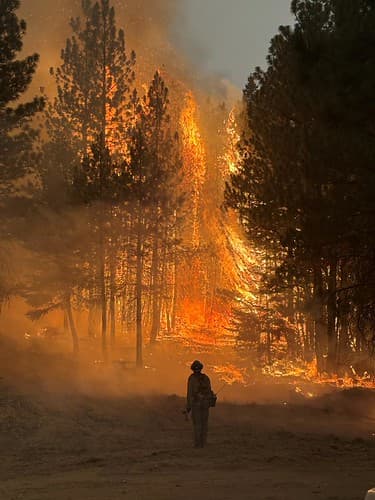
Wildfires 2026 — daily update. Pollinators are victims too — and they deserve to be counted. They are the great unknown of these fires, absent from the reporting.

View the daily update

Europe

  • Spain — 207,000 ha burned in 2026, six times the same period of 2025. August is the highest-risk month; 2025 remains this century's worst year, with nearly 400,000 ha burned.
  • New active fronts in León, Ávila and Cáceres.
  • Greece — A new wave of fires and evacuations near Athens is driven by strong winds; the greater Athens area is on maximum alert, with temperatures forecast above 42°C. The Boeotia fire burned 10,000 ha and forced over 1,000 evacuations; three firefighters have died nationwide. Another front in Rethymno, Crete remains critical.
  • France — 116,000 ha burned, an absolute historic record and nearly double its previous worst year (2022). The Gironde megafire burned for over a week; a local wildlife sanctuary reports hundreds of thousands of animals killed while fleeing.
  • Portugal — Viseu fire: about 13,000 ha, with aid requested from the EU Civil Protection Mechanism. At peak, 39 active fires were counted nationwide; risk was maximum or very high across much of the country.
  • Italy — Estimates range from 40,000 to more than 100,000 ha nationwide; Sicily and Calabria are the worst-hit areas. No single consolidated official figure is available.
  • European Union — 254,000–275,000 ha burned since January, more than double the 2006–2025 historical average. Over 300,000 people were evacuated or confined in France and Spain during July; the figure is still rising with Greece's August crisis.

Africa

  • Algeria — At the July 18 peak, 154 fires were declared in 24 hours; 6 people died and about 150 homes were affected in Annaba. Residents fought the fire with their bare hands due to lack of resources.

Asia

  • Turkey — About 95,000 ha burned, seven times the 2008–2020 historical average for this time of year.
  • Russia (Siberia) — About 600,000 ha burned cumulatively in 2026; 84,356 ha were active at peak in Krasnoyarsk, Yamalo-Nenets and Irkutsk. Authorities link the increase to anomalous temperatures.

North America

  • Canada — 3,848 fires and 2.92 million ha burned since January. Ontario is the hardest-hit province: Thunder Bay 36 has burned 314,000 ha and remains uncontained.
  • United States — Fire alert raised to maximum level.

South America

  • Ecuador — On August 11, seven fires were active and four controlled, according to the National Risk Management Secretariat. The Cotacachi-Cayapas Ecological Reserve fire has burned at least 300 ha of páramo, threatening protected flora and fauna. More than 4,000 ha burned nationwide in early August; the Cuambo fire burned 1,443 ha before it was extinguished on August 5.
  • Brazil — 1.76 million ha burned in 2026 (satellite/GWIS), with 4,682 fire events. The Ministry of Environment warns of greater risk from August to October as the dry season begins.

Oceania

  • Australia — The southern-summer fire season (December–May) has passed. January's peak burned more than 400,000 ha in Victoria alone, with a state of disaster declared in 18 local governments. It is now southern winter, with no significant activity.

Global context

Sources: MITECO, EFFIS/Copernicus, French Interior Ministry, Portuguese Civil Protection, Italian Civil Protection, Algerian Civil Protection, Turkish Meteorological Service, Russian Federal Forest Agency, Government of Canada (CIFFC), GWIS/Brazil Ministry of Environment, Ecuador SNGR/ECU 911, AFAC/NEMA Australia, Reuters, France 24, CNN, Greenpeace Spain, NOAA, Copernicus Marine Service.

S.A.N. Code Calculator

Fibonacci Nomenclature System — assigning a unique numerical identifier to every species in the Nahiara universe

Calculate SAN Code

Enter the complete scientific name of any species

Verified Examples

Click to test with verified reference species

How It Works

1

Enter the scientific name — use the complete official scientific name of the species.

2

Select a category — F for flowers, P for pollinators, G for guardians.

3

Each letter maps to a Fibonacci value — all letters are converted to lowercase, then each letter's Fibonacci value is summed. Spaces and punctuation are ignored.

4

The result is the SAN number — formatted as SAN-{category}-{number}

SAN Code Format

🌸

SAN-F-XXXXX

Flower

🐝

SAN-P-XXXXX

Pollinator

🛡️

SAN-G-XXXXX

Guardian

Part of the original scientific protocols of the Nahiara universe